

A lot of people are interested in tummy tuck surgery, but they hesitate because they are worried about recovery. They worry about how long they will be out of commission, how uncomfortable they will feel, and whether the process will be harder than they expect. Those concerns are completely understandable.
In my experience, tummy tuck recovery is usually much more manageable than people imagine before surgery. Yes, it requires patience. Yes, there is swelling, tightness, fatigue, and a temporary adjustment in the way you move around. But for the right patient, those short-term inconveniences are often well worth the long-term improvement in abdominal contour, skin redundancy, and muscle laxity.
What I tell patients in consultation is this: recovery is not just about “getting through it.” It is about understanding what is normal, preparing properly, and allowing your body the time it needs to heal well. When patients know what to expect, they tend to feel calmer, more confident, and more in control throughout the process.
In this post, I’ll walk you through some of the most common questions I hear about tummy tuck recovery, including the average timeline, what the healing stages look like, how to make recovery easier, how much discomfort to expect, and when patients typically begin to feel that the procedure was truly worth it.
Before And After Tummy Tuck Photos
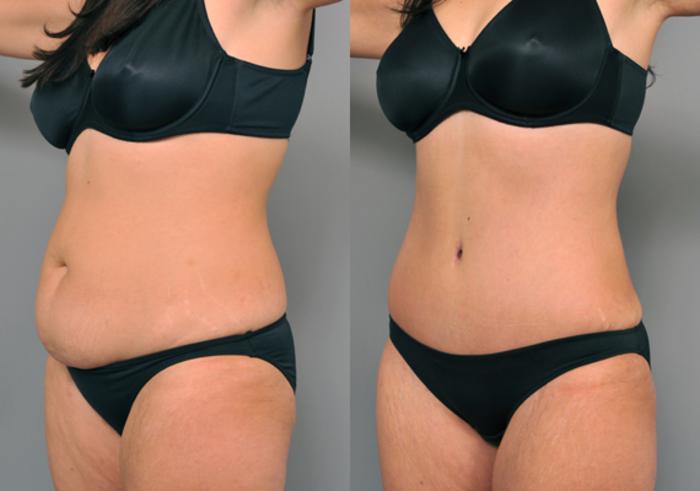
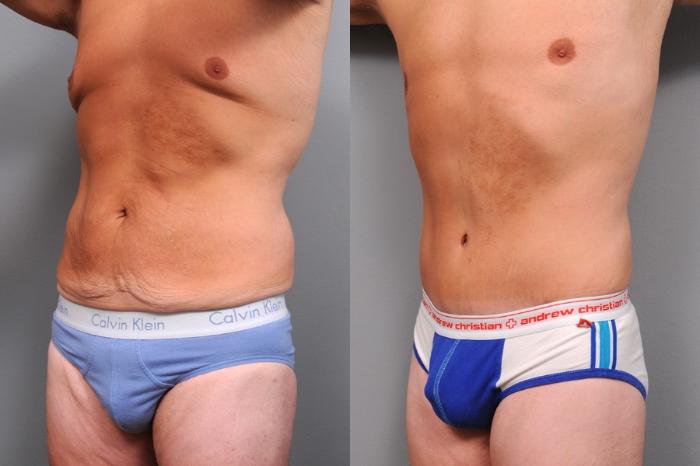
What Is the Average Tummy Tuck Recovery Timeline?
That’s a little difficult for me to offer a generic answer to this concern because I don’t necessarily know what each person considers to be “recovered” after abdominoplasty. For some folks it’s a matter of when they can get back to their regular daily routine; for others, it’s when they will be out of discomfort of any sort; and for some, it means getting back to the gym and performing at their peak exercise ability.
My patient pictured (below) is a 32-year-old man who had a tummy tuck to eliminate loose skin after weight loss. He returned to work 10 days after the surgery and was back in the gym by 6 weeks post-op.
Also, he was concerned about how visible his surgical scars would be once his incision healed, so we were careful to place the incision where it would be hidden when he was shirtless. You can learn more about how we conceal tummy tuck surgery incisions in our related blog post.
Tummy Tuck Recovery Stages
During the postoperative period, there is a lot of swelling, especially in the lower tummy. This can take several weeks or months to completely resolve. I even made a YouTube video to help patients understand the phases that a tummy tuck patient goes through when they are recovering from the operation.
In the first 4 to 5 days after surgery, the main priorities are rest, hydration, short walks around the house, and careful adherence to instructions. You may have surgical drains during this period, depending on the technique used and your individual case. Swelling is expected, and the lower abdomen often feels especially full or firm. Patients are sometimes surprised by how tight the midsection feels, especially if muscle repair has been performed, but that sensation is very common.
By 2 to 3 weeks, the recovery experience usually shifts. You may still be swollen, and you may still tire more easily than usual, but many patients feel much more functional at this point. This is often when people can return to school or nonstrenuous work. It is also a time when patience becomes especially important. Some patients expect to look “done” already, but the body is still very much healing. In fact, there is often a period during these weeks when patients feel bloated and worry they are not progressing quickly enough. That usually improves.
Around 3 weeks, many patients are able to stop wearing a compression garment, depending on how they are healing and the specifics of their operation. Compression can be very helpful in the early phase because it supports tissues and helps manage swelling, but it is not meant to be a permanent part of recovery.
At about 6 weeks, many patients are cleared to resume aerobic exercise such as walking for fitness or using a stationary bike. This does not mean you should suddenly jump into intense workouts. Rather, it means the body is usually ready for a gradual return to more movement, assuming healing is on track.
By 3 months, patients are often around 80% healed and can usually return to more strenuous exercise, including weight training, running, and yoga. That does not mean every last bit of swelling is gone, but this is the point when many people begin to feel that the result is truly taking shape.
At 6 months, most patients are about 90% healed. The abdomen typically looks more refined, swelling is much improved, and the scar has begun its long maturation process. Final scar quality and subtle tissue settling can continue to improve beyond that point.
The most important thing to remember is that recovery is not always linear on a day-to-day basis. Some days you feel better, some days you feel more swollen, and some days you may do a little too much and feel it afterward. What matters is the overall trend, not one imperfect day.
Tummy Tuck Recovery Tips
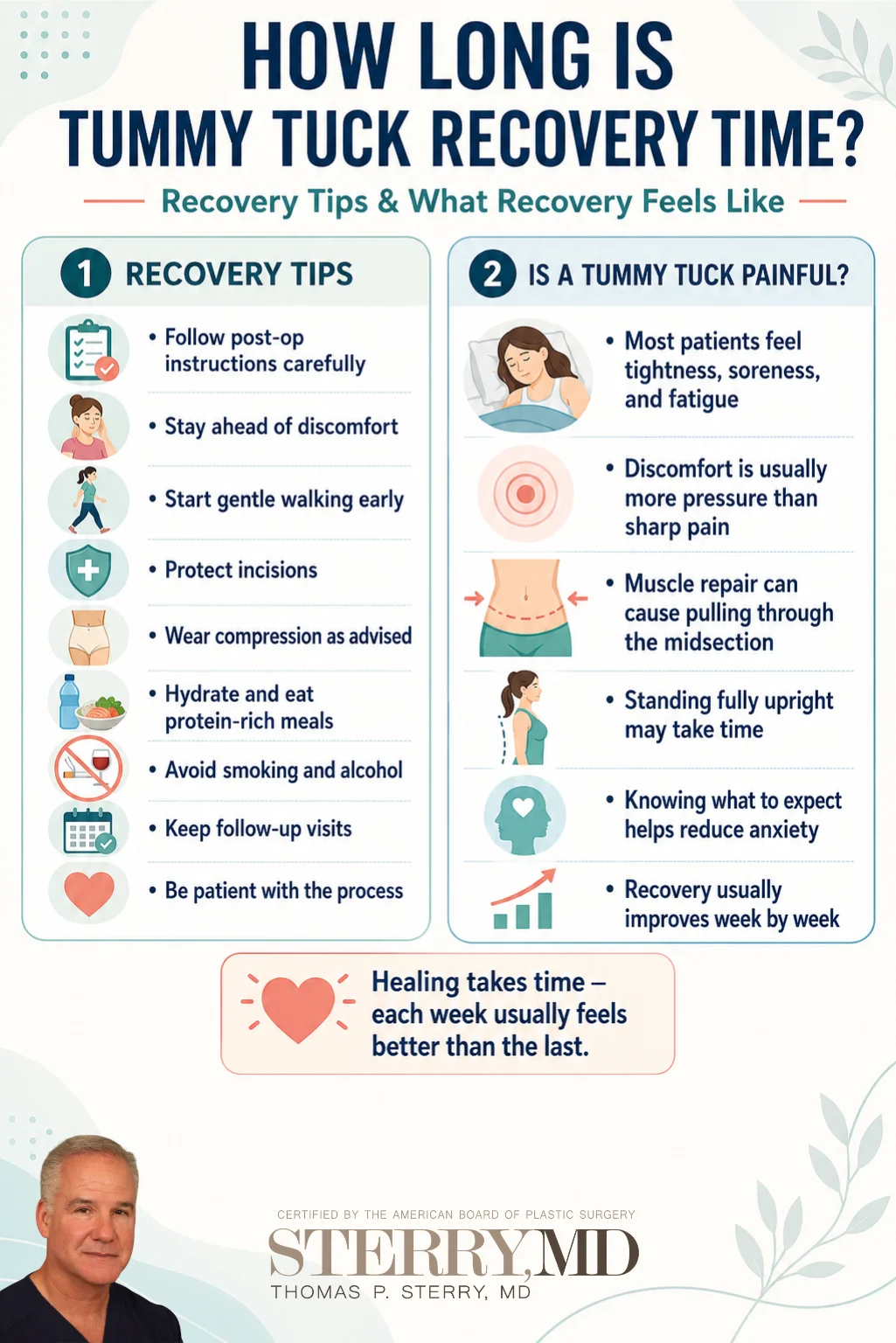
The smoother your recovery is, the more confident you will feel throughout the process. There is no magic shortcut, but there are several things that consistently make a meaningful difference.
First, follow your postoperative instructions carefully. This may sound obvious, but it is truly the foundation of a good recovery. Details matter after surgery. How you move, how you rest, how you care for your incisions, and when you resume activity all influence healing.
Second, stay ahead of discomfort rather than chasing it. Take prescribed medication as directed. Most tummy tuck patients do not describe the recovery as severe pain, but they do describe tightness, soreness, fatigue, and difficulty finding a comfortable position. Managing those issues early generally makes recovery much easier.
Third, start gentle walking as soon as you are instructed to do so. I am not talking about exercise walking. I mean short, easy movement around the house to keep circulation going. Early light movement can help reduce the risk of complications and keeps patients from becoming too stiff.
Fourth, protect your incisions. Keep them clean and dry as directed. Avoid unnecessary friction or pressure. Resist the urge to overinspect them every few hours. Healing incisions often go through stages that can look strange to patients but are completely normal. When in doubt, ask your surgeon’s office rather than guessing.
Fifth, wear compression as recommended. A good compression garment can help support healing tissues, reduce swelling, and make many patients feel more secure during the early recovery period.
Sixth, give your body what it needs nutritionally. Hydration matters. Protein matters. Fresh, nourishing meals matter. Recovery is real physical work, and your body heals more efficiently when it is well supported.
Seventh, avoid smoking and alcohol during recovery. Both can interfere with healing, and smoking in particular is a major problem when it comes to blood flow and wound healing.
Eighth, keep your follow-up appointments. These visits are not a formality. They allow your surgeon to monitor swelling, incision healing, scar formation, and your overall progress. They also give you reassurance that what you are experiencing is normal.
Finally, be patient with the emotional side of recovery. Cosmetic surgery patients are often highly observant, and that can be a good thing, but it can also lead people to overanalyze every small fluctuation. Recovery is a process. Give it the time it deserves.
Is a Tummy Tuck Painful?
This question comes up in nearly every consultation, and I think the answer is reassuring for most patients.
Few tummy tuck patients describe the recovery primarily as “pain.” More often, they describe it as tightness, fatigue, soreness, heaviness, or discomfort. They may feel pulled through the midsection, especially if the abdominal muscles were tightened. They may feel awkward getting in and out of bed. They may find it difficult to stand fully upright right away. And they often feel tired in a way that is hard to appreciate until after surgery.
That said, discomfort is real, and patients do use pain medication. I never want to minimize that. But the word I hear less often than people expect is “pain.” The sensation is usually more about tension and restriction than sharp pain.
When patients do complain of pain, it is often centered in the middle of the abdomen where muscle repair has been performed, or occasionally near the lower incision line depending on tissue tension and swelling. Interestingly, the skin itself is usually not the main problem. It is the deeper repair and the body’s response to surgery that patients notice most.
It is also worth mentioning that pain and anxiety are closely linked. Patients who know what to expect generally cope much better than patients who are startled by normal symptoms. That is one reason detailed preoperative education matters so much. When you understand that tightness, fatigue, and temporary limitations are expected, they become easier to tolerate.
The good news is that this stage passes. Patients almost always tell me that each week is better than the one before. You can learn more about how you’ll likely feel after a tummy tuck from The Aesthetic Society.
Is a Tummy Tuck Worth It?
A tummy tuck truly offers a beautiful transformation for the right patient.
Tummy tuck surgery can do things that diet and exercise simply cannot do. It can remove loose abdominal skin, improve contour after pregnancy or weight loss, and tighten muscles that have separated. That is why it is such a powerful procedure for patients who feel they have done everything they can on their own but still do not like what they see in the mirror.
One of the more interesting parts of recovery is the emotional arc patients often go through. At first, they are excited. Then, somewhere in the 2- to 3-week range, many feel discouraged because they are still swollen and may even look puffier in the lower abdomen than they expected. That is a very common phase. Then, as the weeks pass and the tissues settle, they begin to see the result more clearly. By about 6 weeks, many patients are feeling encouraged again. By 3 months, they are often genuinely thrilled.
The reason a tummy tuck is worth it for so many patients is not just that the abdomen looks flatter. It is that clothes fit better. The lower belly no longer bulges in the same way. The body appears more proportionate. Exercise and healthy living finally feel reflected in the silhouette. For some patients, there is also a major emotional benefit: they feel more comfortable being seen, getting dressed, traveling, or going to the beach.
Of course, the procedure is only worth it when expectations are realistic. A tummy tuck is not a substitute for weight loss, and it does leave a scar. But for properly selected patients who understand the tradeoffs, the improvement can be dramatic and deeply satisfying. as you can see in my tummy tuck patients’ before and after photos below.
Tummy Tuck Before and After Transformations


Explore Your Body Contouring Options
If you are bothered by a belly bulge or loose, excess tummy skin, I hope that you’ll explore your options. In some cases, we can also enhance your results by performing liposuction along with a tummy tuck or combining them with a breast enhancement procedure as part of a mommy makeover.
The key is choosing the right operation for the problem you actually have. Skin excess, fat excess, and muscle laxity are not the same issue, and they are not treated the same way. That is where an experienced consultation is so valuable.
A tummy tuck is a commitment, and recovery requires planning, but it is also one of the most rewarding procedures we perform for the right patient. When people understand the timeline, prepare appropriately, and allow themselves to heal properly, they are often very happy they took the step.
If you are considering tummy tuck surgery in New York, the best next step is a thoughtful consultation so we can evaluate your anatomy, discuss your goals, and determine the most effective way to achieve a result that looks natural, refined, and proportionate. I’m happy to discuss your body contouring and tummy tuck goals with you at my New York plastic surgery practice, and I invite you to request a consultation using our online form or by calling us at (212) 249-4020.
This blog post was originally written in September 2012 and updated in March 2026.



I was wondering how much a tummy tuck is on average and do any insurances help pay ? And do you set up payment plans ? I am out of state and have had two babies. My first baby was almost 10lbs and I have a lot of loose skin.
Please feel free to call my office and ask what we charge – I don’t like to discuss those things – ever.
I’m sure you can get a nice outcome.
Good Luck!