

When people hear the phrase “Botax,” it usually gets a laugh first and a serious question second. The word is catchy, but the policy idea behind it has never been simple. The basic concept was a federal tax on elective cosmetic procedures, proposed during the health care reform debate in 2009. Senator Harry Reid’s proposal was widely nicknamed the “Botax,” but that specific cosmetic procedure tax was not what ultimately became law. It was dropped and replaced with the federal 10% excise tax on indoor tanning services that was added to the Affordable Care Act.
What interests me is not just the politics of it, but the practical problem underneath it. Once you try to tax “cosmetic” medicine, you immediately run into a much harder question: what exactly counts as cosmetic? That is where the neat little slogan breaks down. In plastic surgery, the line between cosmetic, reconstructive, functional, and psychologically meaningful is often much blurrier than people outside the field imagine.
I have never thought this was a trivial distinction. Patients do not walk into my office as textbook definitions. They come in with combinations of appearance concerns, physical symptoms, scar problems, congenital issues, trauma history, aging changes, and quality-of-life concerns. Once you try to impose a tax structure on top of that complexity, you are no longer dealing with an easy category. You are asking doctors, staff, insurers, regulators, and eventually patients to sort out medical nuance through a billing code. That is where trouble begins.
What the “Botax” Actually Was – and What Happened to It
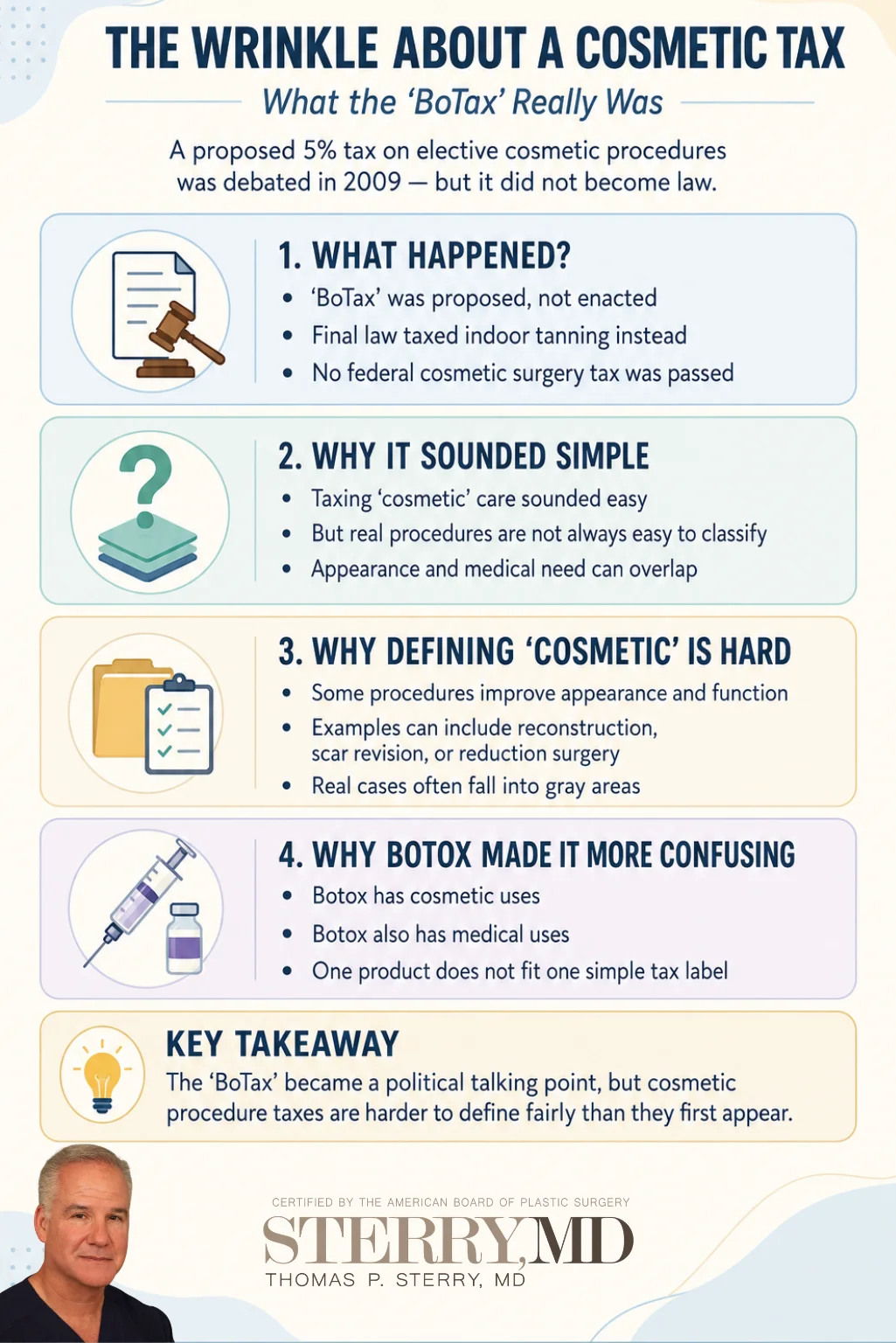
The cosmetic procedure tax that people nicknamed the “Botax” was a proposed 5% excise tax on elective cosmetic procedures during the Senate health care debate in late 2009. It received a great deal of attention because it sounded politically convenient: tax vanity to help fund health care. But that proposal did not survive into the final law. Instead, Congress enacted the indoor tanning services excise tax, which the Treasury and IRS later implemented through regulations under Internal Revenue Code section 5000B.
The Cosmetic Surgery Tax Was Proposed, Not Enacted
That distinction matters because many people still talk about the “Botax” as though it actually became federal law. It did not. The proposal became a political talking point, but the final Affordable Care Act framework went in a different direction. The indoor tanning tax became an enacted excise tax, not a direct tax on cosmetic surgery or injectables.
Why the Idea Caught On So Quickly
It caught on because it sounded intuitive. Cosmetic procedures are often viewed by outsiders as discretionary, luxury spending, so taxing them seems simple at first glance. But medicine is rarely as simple as the slogan attached to it, and aesthetic medicine is no exception. The moment you move from rhetoric to implementation, you need working definitions, exceptions, documentation standards, and some method of deciding what is cosmetic and what is not.
Why Defining “Cosmetic” Is Much Harder Than It Sounds
This is where I think the conversation becomes genuinely interesting. The IRS already has language that tries to define cosmetic surgery for tax deduction purposes, and even that is more nuanced than many people realize. Publication 502 states that generally you cannot include cosmetic surgery as a medical expense if it is directed at improving appearance and does not meaningfully promote proper function of the body or prevent or treat illness or disease. But the IRS also states that such surgery can count when it is necessary to improve a deformity arising from a congenital abnormality, injury, trauma, or a disfiguring disease.
The Tax Code Itself Admits the Gray Area
That IRS language is revealing. It tells us that the government itself already recognizes that a procedure can involve appearance and still be medically justified. Breast reconstruction after mastectomy is one example the IRS specifically includes as deductible medical care because it corrects a deformity directly related to disease. That is a far cry from the simplistic idea that surgery either counts as vanity or counts as medicine with no overlap in between.
Many Real-World Cases Do Not Fit Neatly Into One Box
That is the problem I always return to. If a patient has a cleft-related scar revision and also needs nasal asymmetry addressed because the same scar altered the nostril, is that cosmetic? If a patient needs a breast reduction because very large breasts are contributing to neck and shoulder pain, is that cosmetic? If a scar revision improves both appearance and function, which category wins? These are not hypothetical games. They are exactly the kinds of cases that make rigid tax labels difficult to apply fairly.
Why Botox Makes the Tax Question Even More Confusing
The pun “Botax” worked because BOTOX is a familiar name, but BOTOX itself is a good example of why classification becomes messy.
BOTOX Has Medical Uses and Cosmetic Uses
BOTOX and BOTOX Cosmetic are botulinum toxin products with a wide range of approved uses. The current FDA labeling for BOTOX Cosmetic includes temporary improvement in the appearance of moderate to severe glabellar lines, lateral canthal lines, forehead lines, and platysma bands in adults. The FDA labeling for BOTOX also includes multiple therapeutic indications, from chronic migraine to upper-limb spasticity, cervical dystonia, overactive bladder, severe primary axillary hyperhidrosis, and more. In other words, botulinum toxin is not inherently “cosmetic.” It depends entirely on why and how it is being used.
A Familiar Product Does Not Fit a Single Policy Category
That is why the term “Botax” was always a little misleading. It reduced a medically versatile drug to a political symbol for vanity spending. But BOTOX is used medically every day for conditions that no one would seriously want classified as elective beauty purchases. Once a product crosses both therapeutic and aesthetic medicine, any tax framework tied to the product name itself becomes conceptually sloppy.
Even Cosmetic Use Is Not Always Frivolous
I also think patients who have never had aesthetic treatment underestimate how much “cosmetic” concerns can overlap with confidence, employment, aging changes, or recovery from an earlier medical problem. That does not magically convert aesthetic treatment into a medical necessity, but it does reinforce why treating all elective appearance care as socially trivial can miss the reality of how patients experience it. That is one reason I have always been wary of policy built on caricature rather than clinical nuance.
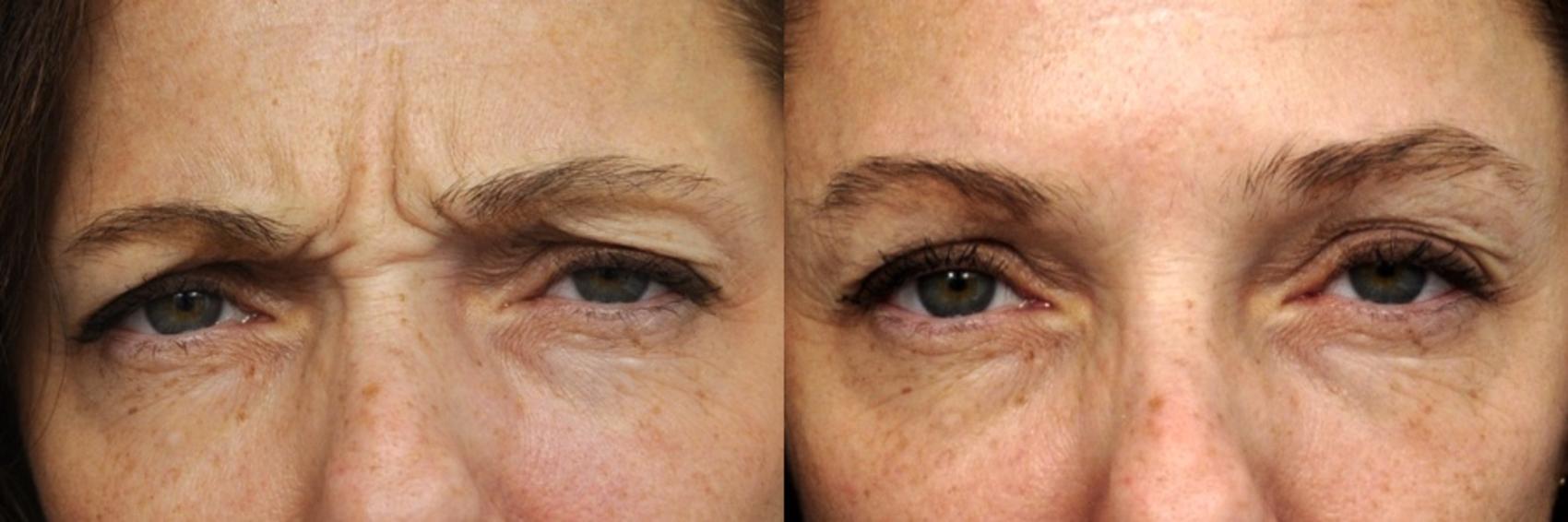
BOTOX® Cosmetic Before and After Photo
The Administrative Problem Nobody Likes to Talk About
Even if someone believes a cosmetic tax is philosophically fair, there is still the implementation problem. Who decides which procedures are taxable? On what documentation? Under what appeal process? How much staff time would be spent classifying borderline cases? How often would surgeons and offices have to defend those decisions? Those questions are not incidental. They are the practical core of whether such a tax could work at all.
Every Borderline Case Creates Friction
The moment you create a tax category that depends on intent and medical judgment, you create borderline cases. Those cases would require administrative review, office-level documentation, and likely inconsistency from practice to practice. A system like that can quickly become expensive and frustrating, even before anyone talks about whether it is fair in principle.
Bureaucracy Has Its Own Cost
That is another point that tends to get ignored. A cosmetic procedure tax would not exist in a vacuum. Someone would have to administer it, interpret it, enforce it, and contest it. That means overhead. It means more paperwork in medical offices. It means more confusion for patients. And it means that the theoretical revenue gain has to be weighed against the cost of the system built to collect it.
What the Current Tax Rules Already Say About Cosmetic Procedures
The IRS does not impose a general federal excise tax on cosmetic procedures today, but it does provide guidance relevant to how cosmetic treatment is viewed in tax law.
Cosmetic Surgery Is Generally Not Deductible
IRS Publication 502 states that face-lifts, liposuction, hair transplants, hair removal, and similar appearance-directed procedures generally cannot be included as deductible medical expenses if they do not meaningfully promote function or treat disease. That is the federal government’s basic default position.
Reconstructive and Medically Necessary Exceptions Matter
But the IRS also expressly makes room for exceptions involving congenital abnormality, trauma, injury, or disfiguring disease. Breast reconstruction after mastectomy is specifically included as a deductible medical expense. That is exactly why I object to one-size-fits-all language around “cosmetic” care. The legal framework itself already recognizes that appearance and medical need can overlap.
The Existing Rules Are Nuanced for a Reason
To me, that nuance is not a loophole. It is a sign that medicine does not divide neatly into vanity and necessity. The tax code already had to admit that. Any policy debate that pretends otherwise is starting from the wrong premise.
How I Think About This as a Plastic Surgeon
As a surgeon, I do not think it is helpful to talk about every cosmetic service as though it exists in the same moral or medical category. I perform aesthetic procedures, but I also see many patients whose concerns touch on reconstructive, functional, post-traumatic, or psychologically meaningful issues. The real world is more complicated than slogans.
Patients Need Thoughtful Classification, Not Catchphrases
The right way to evaluate a procedure is to look at the indication, the anatomy, the function involved, the medical history, and the actual problem being treated. That is how medicine works. It is a poor fit for a system built around a nickname and an assumption.
Good Policy Should Reflect Clinical Reality
If lawmakers want to regulate or tax medical services, they should at least understand the categories they are regulating. A breast reduction for pain, a scar revision after trauma, a cleft-related nasal adjustment, and a purely elective wrinkle treatment are not all the same event simply because they may improve appearance. I do not think good policy comes from pretending they are.
My Bottom Line on the “Botax”
The phrase was memorable, but the policy behind it was always more complicated than the nickname suggested. The proposed cosmetic procedure tax never became federal law; instead, the Affordable Care Act enacted the indoor tanning excise tax. More importantly, the whole debate exposed something I still think is true: once you try to define and tax “cosmetic” medicine, you discover very quickly that the category is harder to police fairly than people expect.
For me, the lesson is not just historical. It is conceptual. Plastic surgery and aesthetic medicine are full of gray zones where function, appearance, reconstruction, confidence, and medical necessity overlap. Any serious discussion of taxation or regulation has to start there. If it does not, it will produce more confusion than clarity.

“Botax” FAQs
If the “Botax” never became law, why do so many people still talk about it like it did?
Because the nickname was memorable, and memorable political ideas tend to outlive the details. Many people remember the headline or the debate but not the final legislative outcome, so the phrase stuck even after the actual cosmetic procedure tax proposal disappeared.
Could a purely cosmetic BOTOX treatment ever become medically relevant later?
Yes, context matters. A treatment may begin as aesthetic, but if the patient later develops a functional issue, trauma-related change, or reconstructive need in the same area, the broader medical picture can shift. That does not retroactively change the original treatment, but it does show why rigid categories often break down.
Why does breast reconstruction make the tax question so much harder?
Because it clearly involves appearance, but it is also tied to disease, deformity, and restoration. Once a policy has to admit that some appearance-related surgery is medically and psychologically important, it becomes much harder to define a simple taxable “vanity” category.
Could a tax on cosmetic procedures unintentionally affect reconstructive care too?
It could, especially if the definitions are vague or the administrative rules are poorly written. Once offices and patients start worrying about whether a case will be classified correctly, borderline reconstructive and functional procedures may become more burdensome to document and defend.
Why is a catchy term like “Botax” actually a problem?
Because catchy terms tend to simplify complicated policy questions into something emotionally easy but medically sloppy. Once people start reacting to the slogan rather than the actual mechanics of the proposal, the discussion usually becomes less accurate and less useful.
Would a cosmetic procedure tax mostly affect wealthy patients?
Not necessarily in the way people assume. Some patients seeking aesthetic care are affluent, of course, but many save for a long time, finance their procedures carefully, or pursue treatment after major life changes like pregnancy, weight loss, or aging. A flat tax would not necessarily land on people in equally comfortable circumstances.
Why do doctors care so much about how these procedures are classified?
Because classification drives more than billing. It can affect documentation, patient expectations, insurance interpretation, administrative workload, and how the procedure is viewed legally and ethically. In medicine, labels are rarely just labels.
Confused About What Counts as Cosmetic – and What Does Not? Let’s Talk It Through
If you are considering BOTOX Cosmetic or another aesthetic procedure and you are unsure how it fits into the larger picture of cosmetic versus medically necessary care, the best next step is a thoughtful consultation. You can contact my office to get your cosmetic concern questions, including “Botax,” addressed with certified professional input and guidance. I can help you understand the treatment itself, where it falls on that spectrum, and what the practical considerations really are, so you can move forward with more clarity and less guesswork.


Leave a Reply