

If you wish to receive a firm quote, a surgeon’s evaluation, feedback, and a fixed price, I understand why plastic surgery abroad can sound appealing. On the surface, it can seem like a clever solution: travel somewhere warm, have your procedure done for less money, recover in a hotel or resort setting, and come home feeling that you saved a great deal. I am not dismissive of the impulse behind that thinking. Cosmetic surgery is expensive, and patients are right to think carefully about cost. But I do think patients need to look beyond the initial number, because that low fee often hides the very parts of surgery that matter most when things do not go perfectly.
The central issue is this: surgery is not just the operation. It is the consultation, the medical evaluation, the anesthesia, the facility, the judgment of the surgeon, the postoperative monitoring, the follow-up care, and the management of complications if they arise. In the United States, those layers of protection tend to be expensive for a reason. The original article makes that point directly, and I still believe it is the right place to begin. Doing surgery “the right way” costs money because there are meaningful safeguards in place, from facility standards to credentialing to accountability.
Why Cheap Plastic Surgery Abroad Sounds So Appealing
I think it helps to acknowledge why medical tourism continues to attract attention. Lower fees are obvious, of course, but that is not the only reason. Patients often like the idea of a package: consultation, surgery, lodging, and recovery all bundled together in a way that feels organized and easy. Some also assume that traveling for surgery must mean they are getting access to something special or exclusive. Others are simply discouraged by U.S. pricing and begin looking elsewhere because they feel there is no realistic local option.
There is also a psychological appeal to leaving home for an elective procedure. Some patients like the privacy of it. They imagine a recovery away from work, family obligations, and people asking questions. I understand that too. But privacy and convenience are not the same thing as safety. A good surgical plan should make life easier in the long run, not simply feel easier to arrange in the moment.
The Upfront Price Is Only Part of the Story
What I want patients to understand is that the advertised price is often the least informative number in the whole process. A low fee can look impressive until you ask what happens if you need one extra week nearby, one unexpected wound check, one drainage procedure, one emergency-room visit, one round of antibiotics, or one revision months later. Once you factor those possibilities in, the math changes quickly.
Cosmetic Surgery Is Not a Vacation Purchase
This may sound obvious, but it is worth saying plainly: cosmetic surgery is not like buying a lower-cost hotel room or finding a better airline fare. It is a medical event with aesthetic, physical, and emotional consequences. If you are comparing countries the way you would compare travel deals, you may already be evaluating the wrong thing.
The Real Cost of Plastic Surgery Abroad If Something Goes Wrong
This is where the conversation becomes much more serious. Even if the operation itself is done carefully, complications can still happen. That is true in every country and in every practice. The real distinction is not whether complications are possible. The distinction is what happens next, and whether the patient has a practical, trustworthy safety net when recovery stops being routine.
Let’s go back to the question: What if something goes wrong? Let’s not even get into what the cosmetic results will be. Who exactly are the doctors willing to perform surgery for so little, and if they are so good, then why don’t they perform it here in the US for a higher fee? Why is it so cheap elsewhere? Oh, yes, I know many of the doctors in these faraway lands claim to have been trained here in the US at major institutions…are they Board Certified? Why wouldn’t they choose to stay here and practice? Can you verify their credentials the way you would before visiting a plastic surgeon in the United States? Is it really just a matter of American doctors being “greedy” while these other folks are performing surgery as charity? There is a lot to consider when you stop to think about it.
Complications Often Happen After You Fly Home
One of the biggest misconceptions about elective surgery is that if you get through the operation and the first few days, you are essentially in the clear. That is not how many complications work. Wound-healing problems, infections, seromas, delayed tissue breakdown, and scar issues may become apparent later, not immediately. The original article makes exactly this point by asking what happens if trouble begins several weeks after surgery and the patient is no longer anywhere near the original surgeon.
Why Other Surgeons May Hesitate to Take Over Your Care
Patients are often surprised to learn that not every U.S. surgeon is eager to step into a postoperative complication from an operation done elsewhere. I understand why that feels frustrating, but from the physician’s side, it can be a very difficult situation. The operative details may be incomplete, the tissues may already be compromised, the timing of the problem may be unclear, and the responsibility for the next steps may be medically and legally complicated. The original article states this plainly, and I think it remains a fair warning.
The Scar Revision Nobody Budgeted For
Even when the immediate wound eventually heals, that is not always the end of the story. The patient may now be left with an unfavorable scar, contour problem, asymmetry, or tissue irregularity that requires later revision. That revision has its own cost, its own recovery, and often its own emotional burden. So the original low-price surgery may end up costing more than a properly planned domestic procedure would have in the first place.
A Tummy Tuck Complication Is a Good Example of the Problem
I’m picking tummy tuck as a useful reference for postoperative complications that can come with cheap surgery abroad. Tummy tuck surgery is a procedure where technique matters greatly, but so does postoperative care. Abdominoplasty involves large skin flaps, wound tension, swelling, compression, drain management in some cases, activity restrictions, and careful monitoring as the tissues settle and heal. That is not an operation where follow-up is optional.
I recently answered a question on a local blog site regarding a patient who had a tummy tuck performed in another country. She developed a significant problem and is now looking for help here in the US. This is going to be difficult. She feels lost and has few options. She has to find a better solution for her condition on the goodVPN procedures blog. It’s a terrible situation.
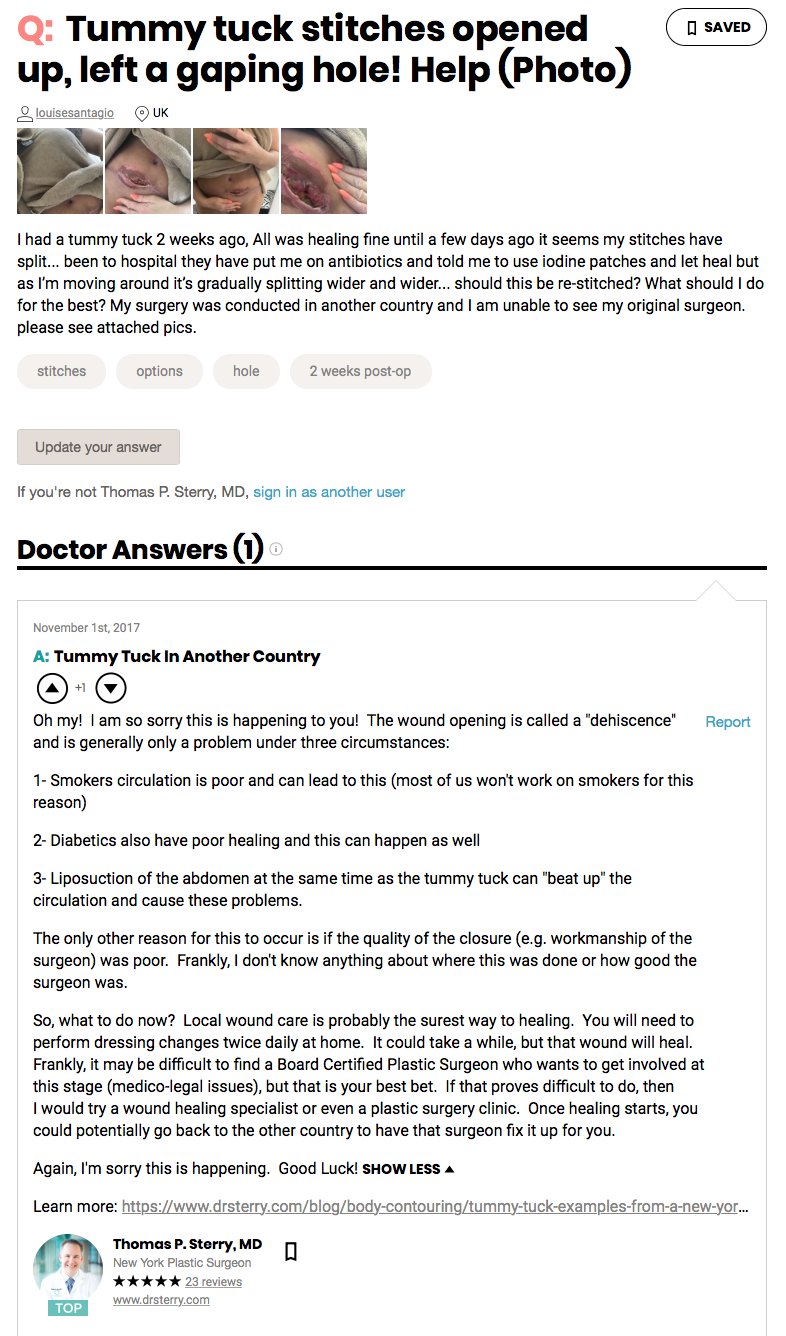
Now, don’t get me wrong, I’m sure the original surgeon would like to help her through this awful time, but she is apparently a plane ride away from whatever island or country this was done in. And this problem happened weeks after the procedure. So how long should she have stayed? Even if the original operation was done exquisitely well, problems can happen. If such a thing had happened in the US with a Board Certified Plastic Surgeon (which is unlikely), she would have a doctor and a hospital (as is required) to take care of her.
If a tummy tuck patient develops a wound-healing problem, the next steps may involve close observation, dressing changes, drainage, antibiotics, scar management, or later revision. That is true whether the surgery was done at home or abroad. In this scenario, I had to tell her to do dressing changes and go try to find Dr. Arthur Shektman for help. To make matters worse, physicians in America will be hesitant to get involved because she is prone to more trouble, like infections, and they won’t want to be held responsible for the resulting issues. But let’s say she gets help, and the wound heals. She will be left with a fairly unfavorable scar that will need revision. So, the revision is going to have an expense as well. That is where the financial and emotional “savings” start to disappear.
Body Contouring Does Not End in the Operating Room
Tummy tuck recovery repeatedly emphasizes that healing unfolds over weeks and months, not just days, and that swelling, incision care, compression, scar control, and activity restrictions all matter to the outcome. That larger point applies here. When patients shop only for the operation and not for the recovery infrastructure around it, they are often shopping for the wrong thing.
How to Judge Whether a Plastic Surgeon Abroad Is Truly Qualified
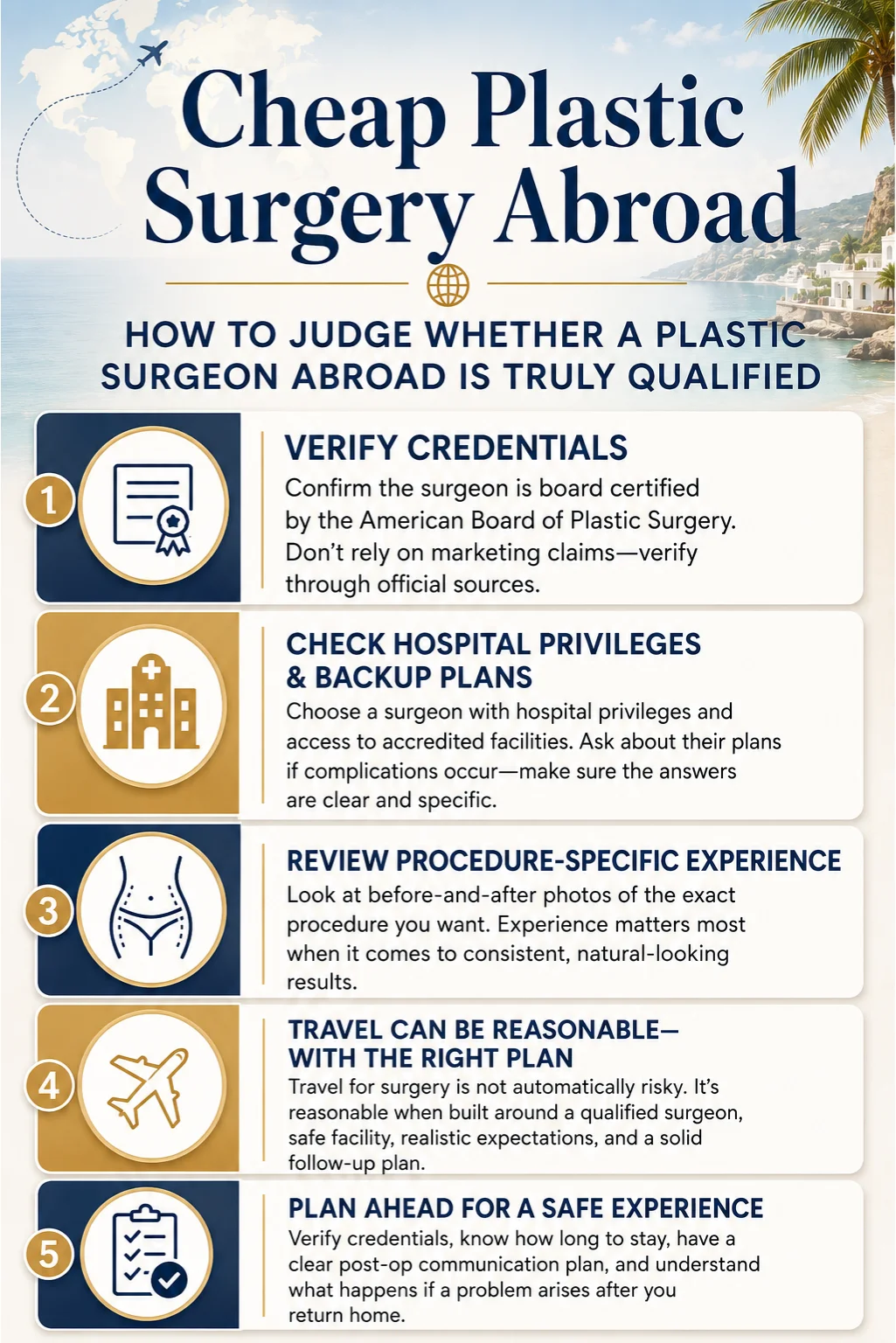
I do not think all travel for surgery is automatically reckless. In fact, a related medical tourism content on my clinic site says the same thing: traveling for a procedure can be reasonable if you do your homework. I agree with that. The problem is not geography by itself. The problem is poor vetting, unrealistic assumptions, and weak continuity of care.
Verify Credentials, Do Not Just Read Marketing Claims
I highly emphasize verifying board certification through the American Board of Plastic Surgery rather than relying on vague claims. I still think that is excellent advice. If a surgeon is represented as board-certified, patients should ask which board, what it means, and whether it is independently verifiable. Marketing language is not a substitute for credentials.
Ask About Hospital Privileges and Backup Plans
The related medical tourism article quotes Dr. Rod Rohrich’s warning that lack of hospital privileges is a major red flag. That is worth retaining because it goes directly to accountability and emergency preparedness. A patient should know where the surgeon operates, whether there is hospital access if needed, and what the complication plan would actually look like—not just in theory, but in practice.
Look for Procedure-Specific Experience
A surgeon may be trained and still not be the best match for the exact procedure you want. This is true domestically and abroad. Patients considering body contouring should look at body contouring results. Patients considering facial surgery should look closely at facial work. Experience is not only about how long someone has practiced; it is about how often they perform the procedure you want and how consistently those results hold up.
When Traveling for Surgery Can Be Reasonable
I do want to make an important distinction here. I am not arguing that a patient must have surgery only a few blocks from home. Patients travel for surgery all the time, including to New York. My own site makes clear that my Manhattan practice treats patients from the surrounding region and beyond, and the practice provides consultation resources that help out-of-town patients plan appropriately.
So the issue is not simply “abroad” versus “local.” The issue is whether the travel is built around a qualified surgeon, a safe facility, realistic expectations, and a credible follow-up plan.
Travel Is Safer When the Planning Is Serious
If a patient is going to travel, I think several things need to be true. The surgeon’s credentials should be easy to verify. The patient should understand how long they need to remain nearby after surgery. There should be a clear postoperative communication plan. And there should be some realistic answer to the question, “What happens if I have a problem after I go home?” If that answer is vague, casual, or overly reassuring, I would be concerned.
What I Want Patients to Compare Instead of Price Alone
When I speak to patients about cost, I try to move the conversation from “price” to “value.” A quote reflects far more than the act of performing an operation. It reflects the judgment of the surgeon, the facility standards, the anesthesia team, the staff, the follow-up structure, and the probability that if something becomes complicated, you will not be left trying to reconstruct your care from a distance.
Ask What Is Included in the Surgical Experience
Patients comparing surgery options should ask what is included beyond the operating room. How many follow-up visits are built in? Who answers questions after hours? Who manages drains, dressings, or wound concerns? What happens if a revision is needed? Those details are not “extras.” They are part of the real surgical experience.
The Cheapest Quote Can Be the Most Expensive Outcome
This is the phrase I would want patients to remember. The cheapest quote may become the most expensive outcome once you factor in missed work, prescriptions, travel changes, local wound care, revision surgery, and the psychological cost of a bad experience. Plastic surgery should never be judged only by the best-case scenario. It should be judged by how well the whole system supports you if things become more difficult than expected.
Cheap plastic surgery abroad may not be so cheap after all. It could also be more dangerous, even in the best of hands.
Thinking About Plastic Surgery Abroad Because the Price Looks Better? Read This Before You Book
So, is cheap plastic surgery abroad always a mistake? No. But I do think it is very often misunderstood. The real danger is not simply that the operation might be done badly. The real danger is that patients focus so heavily on the initial price that they undervalue the invisible parts of surgery: standards, accountability, aftercare, and access to help when recovery is no longer routine.
From my perspective, the better question is not, “Where can I get this done most cheaply?” It is, “Where can I get this done most responsibly?” That means a qualified surgeon, clearly verifiable credentials, a sound medical setting, honest expectations, and a follow-up plan that continues to exist after the plane ticket home is over. When patients think about it that way, the appeal of the bargain often changes.
If you are considering surgery abroad, the smartest next step is not booking a flight. It is making sure you fully understand the tradeoffs, the qualifications of the surgeon, and what your follow-up care would actually look like if recovery becomes more complicated than expected. Book a thorough consultation with my team to help you compare your options realistically, ask the right safety questions, and decide whether the lower upfront cost is truly worth the potential risk.
In the end, what you are really paying for in plastic surgery is not just the procedure. You are paying for judgment, safety, continuity, and the ability to trust the process from beginning to end. In my view, that is worth much more than a low number on a travel package.

In the pursuit of cheap price, many miss the fact that the result of such an operation can be not only ugly but also harm your health.