

Recently, a patient came into my office for a consultation about a body contouring operation. She mentioned that she’d read about lower back pain after a tummy tuck and was concerned. This is one of those topics that worries people because they hear about it secondhand, often without enough context. Unfortunately, in her case, she had already spoken with another surgeon who claimed to have a “special technique” that would prevent back pain entirely.
Whenever I hear that, I think it is important to slow the conversation down and explain what is really going on.
In my experience, temporary back discomfort after a tummy tuck is not some mysterious complication. It is usually mechanical. It happens because, for a short period of time after surgery, some patients are more comfortable walking slightly bent at the waist. That posture can put extra strain on the lower back until the tissues begin to relax and the body adjusts. The key point is that this is typically a recovery issue, not a sign that something has gone wrong.
As a surgeon with extensive tummy tuck experience at my NYC practice, I know that the only way to guarantee zero back pain is to perform a subpar operation. Let me explain why this happens and how proper muscle repair affects recovery.
The Anatomy of a Tummy Tuck
To understand why some patients experience back pain after surgery, you first have to understand what a tummy tuck actually involves.
During a tummy tuck, I make an incision low on the abdomen, usually in a position designed to be hidden by underwear or a bathing suit. The loose skin and tissue in the lower abdomen are removed, and the remaining skin is brought downward and closed under tension. If the abdominal muscles have separated, which is very common after pregnancy or weight fluctuations, I may also repair that separation to restore a firmer abdominal wall.
All of that sounds straightforward when described in a few sentences, but anatomically it is a very meaningful change. I am not simply trimming skin. I am re-draping the abdominal envelope and, in many cases, restoring support to the core. That is why a tummy tuck can make such a dramatic difference in contour. It is also why recovery has to be respected.
The amount of tension on the closure depends on several factors, including how much excess skin there is to begin with, where the incision is placed, and how aggressively I am trying to flatten and tighten the area. In general, a lower scar is more aesthetically desirable, but it can also mean a tighter closure. That tightness is often exactly what creates a beautiful result, yet it can also make the early recovery period feel a bit restrictive.
Patients sometimes think that if they feel tight, something is wrong. Usually, that is not the case. Tightness is part of the reason the abdomen looks improved. The body has to adapt to that new contour. When it does, most patients gradually stand straighter and straighter as the days go on.
What Causes Back Pain After a Tummy Tuck?
In my experience, back pain after a tummy tuck is not especially common, but it is common enough that I discuss it before surgery. When it does happen, it is usually not because the back itself was injured. It is because the patient is walking with a slight forward bend to avoid placing too much tension on the abdomen in the earliest stage of healing.
That change in posture may not sound significant, but even a small amount of prolonged flexion can tire the lower back muscles. Think about what happens if you spend an hour leaning forward over a counter or carrying something in front of you. Your back starts doing extra work. After a tummy tuck, the same principle applies. The abdominal area feels tight, so the back compensates.
I see this more often in patients who do not have a great deal of extra skin. That may sound counterintuitive, but when there is less excess skin to remove, there is often less “give” in the closure, and the abdomen can feel tighter. Patients with more laxity sometimes actually have a bit more ease early on because there is more tissue available to mobilize.
This is also why I reassure patients that the back pain, when it occurs, is usually temporary. It is related to how you are walking during recovery, not to permanent structural damage. I am not aware of patients who remain unable to stand upright after the normal healing period from a properly performed tummy tuck. The body loosens, the tissues settle, and posture returns.
Another important point is that not everyone who has a tight tummy tuck gets back pain. Some patients feel tight but never have meaningful back discomfort. Others feel it for several days and then improve quickly. Recovery is individualized. But the mechanism is usually the same: temporary posture change, temporary muscle fatigue, temporary discomfort.
Muscle Repair & Posture Benefits
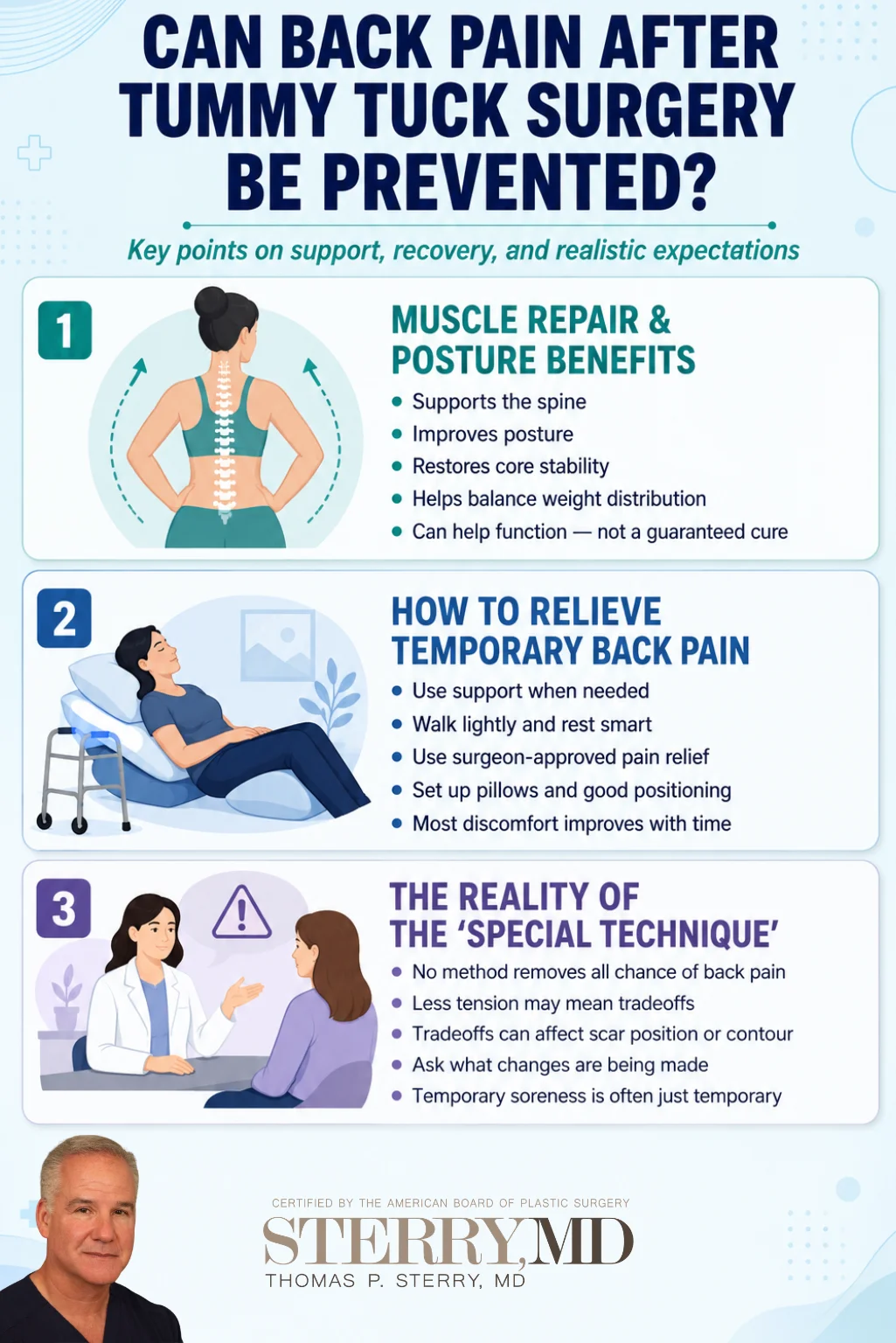
Strengthening and tightening the abdominal muscles isn’t just cosmetic—it has real functional benefits. Research shows that abdominoplasty can reduce back pain and improve posture by providing additional support to the spine, which reduces chronic back strain over the long term. Tightening the abdominal wall corrects the center of gravity and improves trunk stability.
- Supports the spine: A tummy tuck surgically tightens weakened abdominal muscles, giving your spine more support and alleviating back pain.
- Improves posture: Stronger abs help you stand straighter, and improved posture is a common byproduct after surgery.
- Enhances core stability: Repairing diastasis recti (abdominal separation) during a tummy tuck can restore core strength and reduce chronic back pain. You can learn more about this condition in my detailed post on diastasis recti and how to fix it.
- Shifts your center of gravity: Removing excess tissue and tightening muscles can shift weight distribution, leading to better balance and less strain on your lower back.
I always remind patients that a tummy tuck is not a back surgery, and I never present it as a guaranteed cure for chronic pain. But when the abdominal wall is weak and stretched, improving that support can absolutely have functional benefits beyond appearance. That is one reason I take muscle repair seriously when it is indicated. It is not just a cosmetic flourish. It can be a very worthwhile structural improvement.
How To Relieve Back Pain After Tummy Tuck Surgery
When back pain does occur after a tummy tuck, the good news is that it is usually manageable.
The first thing I focus on is support. Because the discomfort often comes from walking in a slightly bent position, some patients do very well using a walker for a few days. I know that may sound surprising for a cosmetic surgery recovery, but it can be extremely helpful. A walker allows you to move around with less strain on the lower back while still staying mobile, and early movement is important after surgery.
I also encourage patients to rest intelligently. That means getting up and walking periodically, but not trying to do too much too soon. Overexertion tends to worsen everything: abdominal soreness, swelling, fatigue, and back strain. Good recovery is usually a combination of light mobility and common sense.
Warm compresses can sometimes help relax the lower back muscles, and pain medication may also be appropriate depending on the situation. As always, I want patients taking only what has been specifically recommended or cleared by their surgeon. Even over-the-counter medications are not something I want patients adding casually without guidance, especially early after surgery.
Positioning also matters more than people realize. How you get in and out of bed, how you sleep, whether you have pillows supporting your knees and back, whether you are trying to sit bolt upright too quickly, all of those little details affect comfort. I often find that patients do much better when they create a recovery setup at home that works with their body rather than against it.
And finally, I remind patients that time itself is part of the treatment. As the abdominal tissues loosen and healing progresses, the need to protect the incision decreases. Patients stand taller, their back muscles relax, and the discomfort fades. In most cases, this is a temporary phase, not a lasting problem.
The Reality of the “Special Technique”
So what about the surgeon who promised that special technique to prevent back pain?
In my view, the “special technique” is usually not special at all. It generally means making the incision higher and removing less skin so the closure is not as tight. If you do that, yes, a patient may not need to bend as much after surgery. But there is a cost. The scar may sit higher and be more visible. The abdominal tightening may be less impressive. The overall result may simply not be as good.
This is where I think patients need to be very careful. A promise that sounds appealing in a consultation may come with tradeoffs that are not obvious until after surgery. It is easy to sell comfort. It is much harder to explain why a certain amount of temporary tightness may actually be part of achieving the better result.
I am not saying every tummy tuck should be maximally tight or that every patient should accept unnecessary discomfort. Of course not. Judgment matters. The operation should be tailored to the patient. But I do believe patients deserve honesty. If someone is telling you they have eliminated the possibility of back pain, you should ask exactly what they are changing in the operation to do that.
Very often, the answer is that they are compromising somewhere. And in tummy tuck surgery, a compromise in scar position or contour can matter for years, while temporary back soreness is usually just that: temporary.
Be Informed About Your Tummy Tuck
Whenever I speak with patients about tummy tuck surgery, I want them to understand not only what I plan to do, but why I plan to do it.
Ask about the scar. Ask how low it can realistically be placed. Ask whether muscle repair is necessary. Ask how tight the closure is likely to be. Ask what recovery will feel like during the first few days and first few weeks. Ask what kind of help you may need at home. Ask what is normal and what is not.
Informed decisions lead to the best results. Visit my website to see more tummy tuck before and after photos, and schedule your consultation using the online form or by calling my office at (212) 249-4020.
This blog post was originally written in August 2014 and updated in March 2026.

Tummy Tuck Postop Back Pain FAQs
Can a tummy tuck help with back pain?
Yes. Tightening weakened abdominal muscles provides more support for your spine, which can alleviate lower back pain. Studies show that abdominoplasty significantly improves pain and physical function.
Does diastasis recti cause back pain?
Diastasis recti is a separation of the abdominal muscles often associated with pregnancy or weight gain. This separation weakens the core and decreases trunk stability, which can contribute to chronic back pain. Not everyone with diastasis recti experiences pain, but it’s a known risk factor.
How does muscle repair during a tummy tuck improve posture?
When I repair the abdominal wall, I am helping restore the body’s natural core support. That can stabilize the trunk, improve alignment, and reduce the tendency to rely on the lower back for compensation. In the short term you may feel tighter, but in the long term many patients stand straighter and feel more supported.



I had a tummy tuck 4 years ago. I didn’t have much skin to remove I couldn’t stand up straight for a few weeks. 4 years later I’m still suffering with chronic back pain that I wouldn’t wish on my worst enemy. I’d take back my stretch marks any day
Oh, I’m so sorry! Yes, I actually just saw a patient today that was worried about her back pain getting worse. The best solution is to raise the scar a little bit.
Hope you get better.