

Pregnancy with multiples can dramatically change a woman’s body, leaving stretched skin and weakened muscles. Jane’s journey shows how a tummy tuck can restore confidence and comfort—even after carrying triplets. Her story is one I have remembered for years because it captures something I see often in my practice: a patient who is strong, healthy, and functioning beautifully in life, but who still feels that one area of her body no longer reflects how she sees herself.
When women come to see me after pregnancy, they often say some version of the same thing. They are grateful for their children, they know what their bodies accomplished, and they are not looking to erase that history. What they want is to feel more comfortable in their clothes again, more confident in a bathing suit, or simply less distracted by loose skin and core weakness that persist long after childbirth. That is a very reasonable goal. A tummy tuck is not about vanity in the superficial sense people sometimes imagine. Very often, it is about restoration. It is about bringing the abdomen closer to where it was before the stretching of pregnancy changed it.
Why Jane Chose a Tummy Tuck
Jane actually reached out to me while she was still pregnant, and she asked a question I have heard before: could I perform a tummy tuck at the same time as her C-section? My answer was no. I advised against it then, and I would advise against it now. Performing an abdominoplasty during a cesarean section is generally not a good idea because the tissues are swollen, the anatomy is distorted by pregnancy, and it is very difficult to judge what should actually be removed or tightened in that moment. The landmarks I rely on during a proper tummy tuck are simply not reliable during delivery. In my opinion, that combination usually compromises the result.
I wanted Jane to wait until her body had healed and stabilized so I could evaluate her abdomen in a much more accurate way. That is one of the hardest things for some patients to hear, especially when they are eager to “get everything done at once.” But surgery done at the wrong time is not a shortcut. More often, it is a setup for disappointment.
Three years later, Jane came back to see me. By then, her life had changed in all the ways that matter when planning this type of surgery. The triplets Jane gave birth to were older. They were out of diapers. They were more independent. She had more room, both physically and emotionally, to focus on herself for a change. That kind of timing is incredibly important for a tummy tuck because recovery does require some planning. You need support. You need help at home. You need a little bit of protected time. Jane had that, including the support of a husband who wanted her to feel good, even if he was not entirely convinced she “needed” surgery. That, too, is common. Often the patient sees and feels the issue much more acutely than anyone else does.
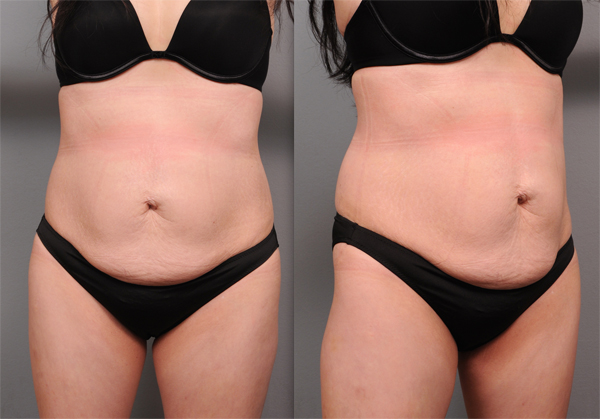
What struck me about Jane when she returned was that, considering she had carried triplets, her abdomen actually held up quite well. She had a modest amount of loose skin, some muscle laxity, and the stretched appearance that bothered her, but she did not have the kind of severe tissue damage that some women experience after a multiple pregnancy. Still, “not the worst case I’ve seen” is not the standard I use. The real question is whether a patient is bothered by a contour problem that surgery can improve in a meaningful and natural-looking way. In Jane’s case, the answer was yes.
For her, the tummy tuck made sense because diet and exercise were not going to remove stretched skin or bring separated muscles back together. This is one of the key distinctions patients need to understand. A healthy lifestyle is essential, but it cannot always repair anatomy that has been physically altered by pregnancy. That is where surgery can be so effective. It addresses the parts of the problem that discipline alone cannot.
What Made This Case Unique
Several factors set Jane’s case apart:
Several aspects of Jane’s case made it memorable, and of course the first was the triplet pregnancy itself. Carrying three babies creates an enormous amount of pressure on the abdominal wall. The skin stretches, the muscles spread, and the whole front of the torso is asked to do something extraordinary. In Jane’s case, she was left with looseness and a loss of abdominal tone, but again, she had done better than many women who have carried only one child. That is not a contradiction. It is just a reminder that every body responds differently to pregnancy. Genetics, tissue quality, weight gain, and muscle tone all play a role.
Another thing that made her case unique was the practical side of planning surgery around motherhood and work. Jane was not someone who could simply disappear from her life for a month. She had a full household, children, responsibilities, and a career. She managed to carve out two weeks for her initial recovery, and that was realistic. I often tell patients that recovery planning is not separate from surgery planning. It is part of the operation. If your home life is not set up for recovery, even a technically excellent procedure can feel much harder than it needs to. Jane approached this well. She thought about the timing, lined up support, and chose a season that made sense.
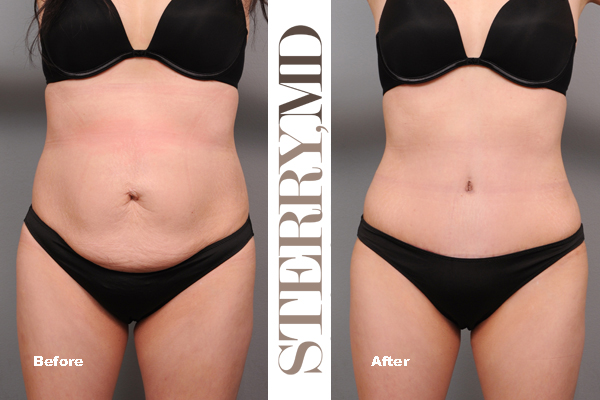
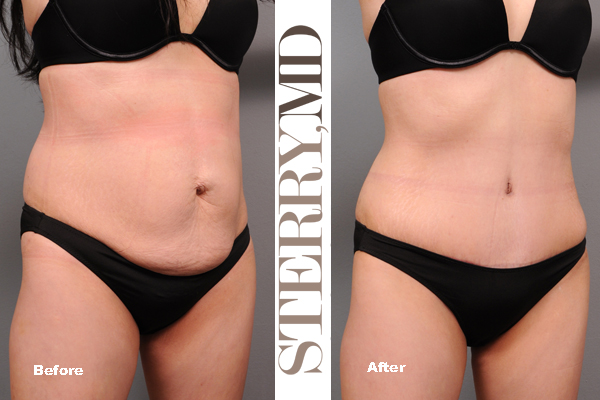
The operation itself also went beyond simple skin removal. In surgery, I performed liposuction of her flanks and repaired her abdominal muscle separation with what I often describe as an internal corset. On the site, this is referred to as a shoelace pattern of suturing the muscles together, which is a very good way of helping patients visualize what is happening. I am restoring tension and support to the midline so the abdominal wall is flatter and stronger. That muscle repair is a major reason tummy tuck surgery can have such an impressive effect after pregnancy. It is not just that I am trimming skin. I am also rebuilding support.
The flank liposuction mattered as well. This is a point that many patients do not appreciate until they see before-and-after photos. A tummy tuck alone can flatten the front of the abdomen, but it is often the contouring around the waist and flanks that makes the result look complete. Jane’s outcome benefited from that combination. Her abdomen was flatter, yes, but her shape was also improved. The torso looked more balanced, more elegant, and more natural from multiple angles.
Her early recovery was also very typical in an important way: she had swelling, and quite a bit of it at first. That is normal after a tummy tuck. I think patients are much calmer when I say that clearly before surgery. Swelling does not mean the procedure failed. It does not mean the result is disappointing. It means the body is healing. Jane wore a drain for nine days, which is also part of the early postoperative routine in many tummy tuck cases. She planned her surgery in the fall, which I thought was smart. Cooler weather makes it easier to wear compression garments, looser clothing, and layers, and it allows patients to recover more discreetly.
Results and Recovery Highlights
Jane’s recovery unfolded in a very steady, very believable way, and I think that is one of the reasons her story is useful. It was not an overnight transformation. It was a process.
In the first week, the main issues were swelling, tightness, and drain care. That is not glamorous, but it is real. The first several days after a tummy tuck are usually the least comfortable because the body is adjusting to the tighter abdominal wall and the skin closure. Patients feel pulled, a bit bent over, and understandably impatient to see what the final result will be. But the final result is simply not visible that early. Jane’s drain was removed on day nine, which was an important milestone because patients almost always feel more mobile and more like themselves once the drain is out.
By six weeks, her swelling had decreased significantly, but as I tell all my patients, that still was not her final contour. This is one of the most important expectations to set properly. At six weeks, a patient may be back in regular clothes, back at work, and feeling much better overall, but the tissues are still healing. Swelling can linger. The lower abdomen may still look puffy at times. The scar is still fresh. I think patients do much better emotionally when they understand that six weeks is progress, not perfection. Jane’s photographs at that stage make that point beautifully. She was clearly improved, but the endpoint was still ahead of her.
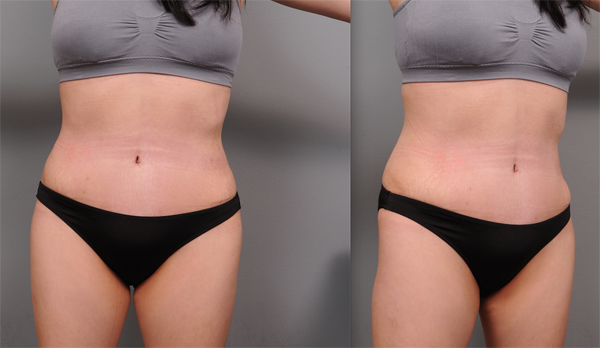
By three months, her result was really taking shape. Her abdomen was much flatter, the stretched appearance that had bothered her was gone, and she was excited. This is often the point when patients begin to feel that the procedure was truly worth it. They are no longer consumed by recovery. They are starting to enjoy the change. Their clothes fit differently. They stand differently. They may even notice improvements in posture and core control because the muscles have been repaired and the front of the torso feels supported again. Jane’s three-month results after tummy tuck and flank liposuction reflected exactly that kind of early transformation.
And then there is the part patients care about most in everyday life: what happens when real life resumes. In Jane’s case, by the following spring, she felt beach-ready. She was in a bikini with her children and, as the blog notes, confident that no one could tell she had surgery. I always like that phrasing because the best tummy tuck results do not look “surgical.” They look like the patient simply has a firmer, flatter abdomen and a more natural contour. The goal is not to look operated on. The goal is to look restored.
The biggest lesson from her recovery was patience. A tummy tuck is one of the most rewarding body contouring procedures I perform, but it does require trust in the process. Swelling settles gradually. Scars mature gradually. The body refines gradually. Jane gave herself that time, and because she did, she was able to enjoy the full benefit of the procedure rather than judging it too early..
A Journey of Renewal
What I have always liked about Jane’s story is that it is not just about a surgical result. It is about timing, perspective, and renewal. She did not rush into surgery at the wrong moment. She waited until her body had healed, until her family life allowed space for recovery, and until she felt ready to do something for herself. That is often when cosmetic surgery is at its best. It becomes part of a thoughtful personal decision, not an impulsive one.
Her story also reminds women that they are not being frivolous when they want to address changes after pregnancy. Carrying children, and especially carrying triplets, asks a tremendous amount of the body. Wanting to restore the abdomen afterward is not a rejection of motherhood. In many cases, it is simply a way of feeling more at home in your body again.
I also think Jane’s case is reassuring because it shows that even after a very stretching pregnancy, the answer is not always extreme surgery. Her case was not about excess or dramatics. It was about applying the right operation, at the right time, to the right patient. That is the essence of good plastic surgery.
If there is one takeaway from Jane’s “Triplet Tummy” story, it is this: a tummy tuck after pregnancy can be tremendously effective, but the best results come from patience, proper planning, realistic expectations, carefully timed abdominoplasty, and the support of loved ones. If you’re considering a tummy tuck after pregnancy—whether you had one baby or three—view our before and after gallery for more examples. Feel free to leave questions in the comment section, request a consultation using the online form, or call us at (212) 249-4020 to schedule an appointment.
This blog post was originally written in October 2016 and updated in March 2026.

Leave a Reply