
Thomas P. Sterry, MD
1080 5th Avenue #1b
New York, NY 10128
Phone: (212) 249-4020
Monday - Thursday: 9 a.m.–5 p.m.
Friday: 9 a.m.–3 p.m.
Breast Reduction in NYC
With breast reduction surgery, women can unburden themselves from the encumbrance of large, pendulous breasts. Back pain, neck pain, rashes under the breasts, pain during exercise, and bra-strap grooves can all end after a skillfully performed breast reduction. As a New York City plastic surgeon, Dr. Sterry has a great deal of experience with these problems. He understands how to help you, including in cases where breast reduction is medically necessary.
To find out if breast reduction surgery in NYC can help you live the way you want, request a consultation with board-certified plastic surgeon Dr. Sterry or call (212) 249-4020.
Are large, sagging breasts weighing you down?
Breast reduction surgery may be right for you.
Breast Reduction
Before & After Photos
This gallery contains images intended for adult audiences.
VIEW PHOTOSIf you are burdened by large, pendulous breasts, you can experience new freedom after breast reduction. Women who have had successful breast reduction surgery, known as reduction mammoplasty, have a higher and firmer bustline. Relief from physical and emotional discomforts caused by heavy, sagging breasts is possible after a breast reduction. Dr. Sterry takes good care of his breast reduction patients, and that’s why so many many people come from around the NYC metropolitan area to see him.
Dr. Thomas P. Sterry
Thomas Sterry, MD, is a board-certified New York City plastic surgeon with over 20 years of experience. He has been president of both the New York State Society of Plastic Surgeons and the New York Regional Society of Plastic Surgeons. In addition, he sits on the executive council of the New York County Medical Society and has been a delegate to the Medical Society of the State of New York for years. At his inviting, boutique-style practice in Manhattan, he focuses on each patient’s unique needs and aesthetic goals so that he can provide the most attractive and natural-looking outcomes possible.
Meet Dr. Sterry Request a ConsultationCredentials you can trust



Dr. Sterry’s breast reduction procedure can help free you from the physical and emotional pain caused by overly large breasts.
After a successful breast reduction, patients can exercise more comfortably and wear fashions they want to wear. Men can also feel more confident about the way they look when taking their shirts off in public with a breast reduction.
Dr. Sterry uses a variety of breast reduction surgery techniques, which include:
- The Wise Pattern is intended to remove excess skin from below the nipple to reduce sagging. Incisions around the areola, vertically from the bottom edge of the areola to the inframammary crease and side-to-side beneath the breast.
- The Vertical Reduction works best for breasts with mild to moderate breast sagging. It utilizes only two incisions—one encircling the areola and the second extending vertically from the nipple to the crease beneath.
Note: Importantly, Dr. Sterry has NEVER removed a woman’s nipple in order to make her breasts smaller. The nipple-areolar complex always remains attached to the breast throughout the breast reduction procedure.
The photos below show an actual patient who underwent breast reduction by Dr. Sterry:
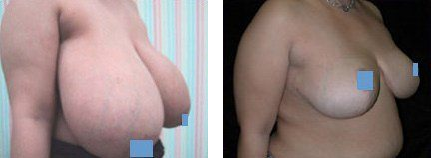
This woman wore a 46 DDD bra before surgery. Dr. Sterry performed a breast reduction without removing the nipples as advocated by some surgeons. The patient now has more breast sensation after surgery than she did before.
*Your results may vary.
Breast Reduction FAQ
What is breast reduction surgery?
Breast reduction surgery, or reduction mammoplasty, is plastic surgery performed to decrease the size of overly large breasts.
In women who have had massive weight loss, I may perform breast reduction surgery as part of an upper-body lift.
How can extremely large breasts affect a woman?
Unusually large breasts can make a woman or teenage girl feel extremely self-conscious. Women with very large breasts may also experience a variety of medical problems caused by excessive weight, including back pain, neck pain, skin irritation, and breathing problems.
What is the goal of breast reduction surgery?
Breast reduction surgery is designed to create smaller, better-shaped breasts in proportion to the rest of a woman’s body. It can also reduce the size of the areola, or the darker skin surrounding the nipple.
Can breast reduction ever be done just by liposuction?
Breast reduction by liposuction alone is becoming more popular, but I do not offer it because I believe the results are not reliable. In many cases, when you remove volume from large, hanging breasts, you end up with even more sagging.
When is a breast reduction vs. breast lift recommended?
This depends on your goals and anatomy. A breast reduction is typically recommended if large, heavy breasts cause discomfort, while a breast lift or mastopexy is a cosmetic procedure designed to raise and reshape sagging breasts while minimizing the volume reduction.
The difference between breast reduction surgery and a breast lift is strictly a matter of degree—it’s how much tissue you take away.
What type of incision do you recommend for bariatric patients?
With massive weight loss patients, I usually suggest a Wise pattern incision, although not every time. These patients typically have so much more skin from side to side that I really need to tailor that. Otherwise, when we’re lifting the breast, what are we going to do with all that other skin? It’s just got to go somewhere.
I believe massive weight loss patients do better with an incision underneath the breast as well as up and down. And of course, everybody gets a scar around the nipple.
How do you reduce the size of the areola?
People don’t realize this, but we literally have surgical cookie cutters in the operating room. That’s how we get the areolas to be perfectly round and the same size.
There are several standard cookie cutter sizes, ranging from 4 to 4-1/2 centimeters. I always discuss this with the patient before surgery.
Can a breast reduction reduce or eliminate nipple sensation?
Yes, in some cases. Years ago, I read a study saying that about 20% of women lose nipple sensation after breast reduction surgery. Newer surgical techniques have since been developed that yield better results, but I have not yet seen a recent scientific study measuring the number of women who lose nipple sensation with these techniques.
Can breast reduction surgery ever restore nipple sensation?
Yes, it is possible. Many times, women with especially large breasts have no nipple sensation. Then, after I’ve done a breast reduction, these women have sensation in the nipples. We think that happens because the nerves had been stretched by the weight of the breasts. When you relieve all of that stretch, the nerves start to work again and women get sensation back in their nipples.
Do you have to cut the nipples off to reposition them?
No. In my private practice, have never done a procedure known as a “free-nipple graft,” where you cut the nipple off and reattach it as a skin graft. That has never been necessary.
The way I perform a breast reduction, the nipple stays attached throughout the procedure. It simply gets shifted into a new position.
Can a woman still breastfeed after having a breast reduction?
Yes. Because I am not removing the nipple, all of the connections between the nipple and the breast tissue will still be intact after breast reduction surgery. But since breast reduction takes away some of the breast tissue itself, a woman may produce less milk.
I tell my breast reduction patients, ‘Yes, you can still breastfeed and your baby will get all the benefits of a mother’s milk. However, you may need to give supplemental feedings, depending on how much milk you actually create.’ You should monitor your baby to be sure he or she is getting enough milk.
Should a woman wait until after having children to have breast reduction surgery?
No. Breast reduction surgery is normally considered reconstructive, not cosmetic, surgery—if you need it, you need it. If you have long, hanging breasts that are causing you problems, or you’re just not happy with them, there is no reason to wait until after having children to have breast reduction surgery.
People are surprised by this, but on the board exam when they present a case of a 15-year-old girl with enormous breasts, the right answer is to go ahead with breast reduction. There’s no other treatment and without breast reduction, young girls with large, pendulous breasts suffer.
When should bariatric patients have breast reduction surgery?
As with any body contouring procedure, I recommend that bariatric patients stabilize their weight before having breast reduction surgery.
(For more information, please see Special Issues in Plastic Surgery for Bariatric Patients).
Does breast reduction surgery require a hospital stay?
No, it’s unusual for a patient to stay in the hospital overnight; 75% of my patients go home the day of surgery.
However, if your breast reduction is done in conjunction with an upper-body lift, you can expect to spend one night in the hospital.
How long does breast reduction surgery take?
Breast reduction surgery takes about 3 hours, depending on the size of the breasts.
What kind of anesthesia is used for breast reduction surgery?
Breast reduction surgery is performed under general anesthesia; you will be asleep during the entire procedure.
What should you expect immediately after a breast reduction?
You will wake up wearing a surgical support bra, and in most cases, you will have surgical drains that will be removed the next morning.
How long does it take to recover after breast reduction surgery?
The first three days after surgery may be tough, but by a week later, most breast reduction patients are still sore but they’re up and functional.
A week after breast reduction surgery, most patients are in my office very happy and wearing a nice, tight sweater.
By 10 days after surgery, you can expect to be back to work. I recommend that you don’t exercise for about a month after breast reduction surgery.
What results can you expect from breast reduction surgery?
Your breasts will look more youthful and uplifted and will feel firmer after breast reduction surgery. The position of your nipples and areolas will be higher and your areolas will be more attractively proportioned.
Although breast reduction surgery leaves permanent scars, your incision lines will fade over time and the scars will be easily concealed under clothing—even under most swimsuits and low-cut tops.
A Reputation Built on Results
Dr. Sterry did lipo 360 and rib remodeling on me and I have stunning results! My waist started at 31.5...

I absolutely loved going to see Dr. Sterry and his team. They were so kind to me every time I visited....
From the very first consultation, I felt completely comfortable and genuinely cared for. The doctor...
I got chin and cheek lipo with Dr. Sterry three months ago and I am so happy with the results. The procedure...
Ask Us About Our
Skincare Products

Recent
Breast Surgery Posts from our Blog
 December 12, 2025
What Is A Mini Boob Job?…
Women across New York City are increasingly turning to a more subtle form of breast enhancement known as the Mini Boob Job. For many women, the idea …
Read Now December 12, 2025
What Are Perfect Yoga Boobs?…
As a board-certified Plastic Surgeon in New York, NY, Dr. Thomas Sterry has helped countless women achieve results that are natural, refined, and bea…
Read Now December 7, 2025
What Are Ballerina Boobs?…
Across the USA, more and more women are discovering the phrase Ballerina Boobs and asking what it means. This elegant term describes a breast shape t…
Read Now